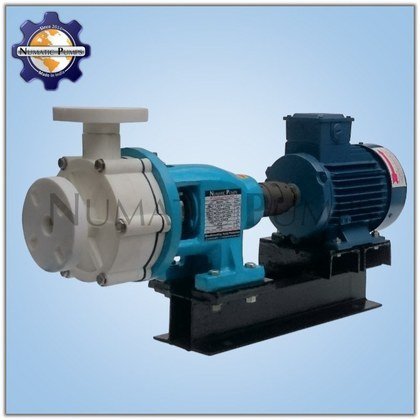
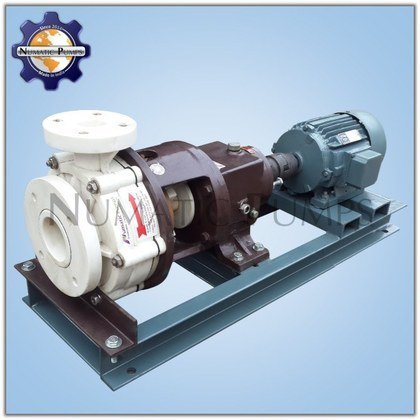
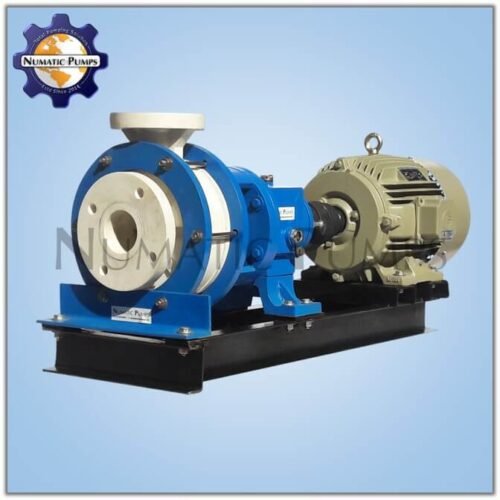
We are manufacturers & suppliers of chemical pumps in Gujarat, Maharashtra, India. Acid pumps are most significant in the safety of the surrounding workforce by preventing exposure of the fluid directly or by the fluid vapourising. When the chemical pumps and acid pumps leak, sulphuric acid, hydrochloric acid, nitric acid and all such acids may also react with exposed metal, releasing toxic fumes. Sulphuric acid is extremely poisonous and attacks the respiratory system, the eyes, the nervous system, the teeth and the circulatory system. Although sulphur acid (H₂SO₄) is non-flammable in its natural state, the formation of hydrogen gas can be extremely dangerous. The hydrogen gas can form where the corrosion of metallic parts, water ingress (such as valves, boilers, absorption systems, etc.) and sulphur react to form the gas. The gas eventually accumulates in ‘pockets’ or stagnant areas of the system and creates a potential risk of explosion. So to avoid the danger to health and the environment, this acid and chemical pump works as a lifeline and reduces lots of handling, circulating and transferring headache.
Chemical pumps are specialised pumps that move different chemicals from one point to another in a regulated and efficient way. They are critical components in many industrial processes that involve the handling and transportation of chemical and acid-reactive liquids, gases, or slurries. These pumps are built in PP, PVDF, SS, and PTFE material to handle corrosive, abrasive, and dangerous chemicals, making them ideal for use in chemical processing, petrochemicals, pharmaceuticals, water treatment, agriculture, and other sectors.
Types of Chemical Pumps
Chemical pumps can be classified by pump construction, drive arrangement, operating principle and material of construction.
Chemical Monoblock Pumps have the pump and motor directly connected as a compact unit. They are suitable for chemical transfer and circulation where a space-saving pump arrangement is preferred.
Chemical coupled pumps use a separate pump and motor connected through a coupling. They are commonly selected for industrial applications requiring flexibility in pump and motor selection.
Magnetic drive pumps use magnetic coupling to transfer motor power to the impeller without a conventional rotating shaft seal. They are particularly useful where minimising leakage is important.
How Are Chemical Pumps Different from Other Centrifugal Pumps?
Chemical pumps are a specialized type of centrifugal pump designed to handle corrosive, aggressive, toxic, or chemically reactive liquids. While their basic pumping principle is similar to standard centrifugal pumps, their materials, construction, sealing, and safety features are designed specifically for chemical service.
Key Difference:
The main difference is not simply the centrifugal pumping principle—it is the pump’s ability to safely handle the chemical being pumped. Material compatibility is critical because an unsuitable pump can suffer from corrosion, seal failure, leakage, or premature damage.
For aggressive chemicals, PP and PVDF chemical pumps are commonly selected because of their strong resistance to many corrosive fluids. Magnetic-drive designs can further reduce leakage risk by eliminating the conventional shaft seal.
The Importance of Chemical Pump Compatibility
Have you ever wondered why you can’t just have a Chemical Pump that can handle any fluid? Chemical compatibility comes into play in this situation. The real impact of chemical compatibility is determined by the material’s resistance to the medium with which it comes into contact. As a result, if a Chemical Pump is pumping a liquid that is incompatible with the material it is made of, there is a problem.
Want to learn more about the consequences of Chemical Pumps incompatibility and how to choose a pump that will work with your fluid? Learn all you need to know about chemical compatibility by reading our article.