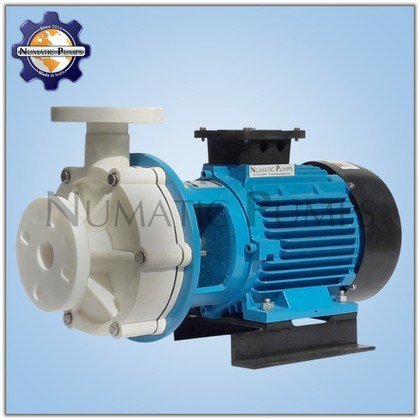
● Pump Type – Centrifugal, Horizontal, Monoblock type, Non Self Priming Pump
● Pump Material – Casing, Impeller and Back Plate is Made of PVDF (Polyvinylidene Fluoride)
● Shaft – EN 8 with Ceramic Sleeve
● Max Head – Up to 14 Meter
● Max Flow – 233 Liter per Minute
● Negative Suction – Maximum 3 Meter with foot valve
● Inlet & Outlet – 25 mm x 25 mm (Flanged end Connection)
● Motor Specification – 1 HP, NFLP, 2800 RPM, 50 Hz, 3 Phase.
● Fluid Temperature – 70° C (Max)
● Seal Type – PTFE (Teflon) Bellow with Ceramic Vs GFT Facings, Ceramic Sleeve
● Impeller – Semi Open Type
We are Top PVDF Acid Transfer Pump Manufacturer & Exporter in Mumbai, India. Our Acid Transfer PVDF Pumps range includes solid injection molded PVDF (Polyvinylidene fluoride) Monoblock Pump, PVDF Lined Pump, PVDF (Polyvinylidene fluoride) Coupled Pump, PVDF Magnetic Drive Pump, PVDF Self Priming Pump.
PVDF Pumps are known for its superior chemical resistance. PVDF Pumps are commonly used for chemicals such as Fresh Water, Salt Water, DI Water, Amyl Acetate, Benzene Sulfonic Acid, Citric Acid, Diesel Fuel, Flu silicic Acid, Formaldehyde, Muriatic Acid, Hydrofluoric Acid, Nitric Acid, Phosphoric Acid, Potassium Permanganate, Sodium Hypochlorite, Sulfuric Acid, Hydrochloric Acid and many more.
Acid Transfer Pumps are a must for applications and industries which need to handle toxic and hazardous chemicals like corrosive acids. These pumps facilitate the overall management and movement of aggressive and volatile chemicals in a safe and hassle-free manner. To manage corrosive acids, certain non-metallic materials which provide the best chemical resistance are used, such as PTFE, PVDF and ceramic. In cases where the pump material provides good chemically resistance, magnetic drive pumps are preferred, as there are no mechanical seals and there are safeguards to prevent leakage of the acids into the environment. Acid Transfer pumps are mainly used in chemical, textile and pharma industries and applications.
• Excellent resistance to stress and highly resistant to cracking.
• High operational temperatures with a melting point of 200°C.
• Excellent strength-to-weight ratio.
• Highly resistant to most alkalis and acid, organic solvents, degreasing agents and electrolytic attack.
Acid Transfer Pumps are a must for applications and industries which need to handle toxic and hazardous chemicals like corrosive acids. These pumps facilitate the overall management and movement of aggressive and volatile chemicals in a safe and hassle-free manner. To manage corrosive acids, certain non-metallic materials which provide the best chemical resistance are used, such as PTFE, PVDF and ceramic. In cases where the pump material provides good chemically resistance, magnetic drive pumps are preferred, as there are no mechanical seals and there are safeguards to prevent leakage of the acids into the environment. Acid Transfer pumps are mainly used in chemical, textile and pharma industries and applications.
Acid transfer pumps are used to safely and efficiently transfer a variety of acids from one location to another. Acids are highly corrosive and require specialized equipment to handle them safely. In this article, we’ll take a closer look at acid transfer pumps, including the types of pumps available, factors to consider when selecting a pump, and best practices for safe handling of acids.
There are several types of pumps that can be used for transferring acids, including centrifugal pumps, diaphragm pumps, and peristaltic pumps.
Centrifugal pumps use a rotating impeller to move the fluid, making them well-suited for high-flow applications. These pumps are often made of materials such as stainless steel, which is resistant to corrosion and can handle a variety of acid concentrations.
Diaphragm pumps are positive displacement pumps that use a flexible diaphragm to pump the fluid. These pumps are often used for low-flow applications and are available in a range of materials of construction, including plastic, stainless steel, and Hastelloy.
Peristaltic pumps, also known as hose pumps, use a flexible tube to move the fluid. These pumps are often used for low-flow applications and are available in a range of materials of construction.
When selecting an acid transfer pump, it’s important to consider several factors to ensure the pump can safely and effectively handle the acid.
Acid Type and Concentration
The type and concentration of acid being transferred will impact the type of pump and materials of construction required. Some common acids include hydrochloric acid, sulfuric acid, and nitric acid. Each of these acids has unique properties and requires specialized handling.
For low-concentration and ambient-temperature applications, plastic pumps may be suitable. However, for high-concentration and high-temperature applications, pumps made from more corrosion-resistant materials such as stainless steel or Hastelloy may be required.
Flow Rate
The flow rate of the acid being transferred will also impact the type of pump required. Centrifugal pumps are generally better suited for high-flow applications, while diaphragm and peristaltic pumps are better suited for low-flow applications.
Acid transfer pumps are used to safely and efficiently transfer a variety of acids from one location to another. Acids are highly corrosive and require specialized equipment to handle them safely. The pumps are used in a variety of industries such as chemical manufacturing, wastewater treatment, and mining, where acids are commonly used for processes such as pH adjustment, metal extraction, and cleaning. The type of pump selected depends on the specific application and the amount of acid that needs to be transferred.
Acid transfer pumps have several features and application benefits that make them a valuable tool for handling acids safely and efficiently. Some of the key features and benefits of acid transfer pumps include:
Corrosion Resistance: Acid transfer pumps are designed to handle highly corrosive fluids, which can damage standard pumps. They are typically made from materials such as stainless steel or Hastelloy, which are highly resistant to corrosion.
Chemical Compatibility: The materials used in acid transfer pumps are compatible with a wide range of acids, ensuring that the pump won’t be damaged or contaminated during the transfer process.
Versatility: Acid transfer pumps are available in a variety of types and sizes, making them suitable for a wide range of applications. They can handle low to high flow rates and low to high acid concentrations.
Efficiency: Acid transfer pumps are designed for efficiency and can transfer acids quickly and safely. This helps to reduce downtime and increase productivity.
Safety: Acid transfer pumps are designed with safety in mind. They are equipped with features such as mechanical seals and venting systems to prevent leaks and fumes.
Easy Maintenance: Acid transfer pumps are easy to maintain and repair. They are typically designed for easy access to internal components, allowing for quick repairs and replacements.
Cost-Effective: Despite their specialized design, acid transfer pumps are often cost-effective when compared to the potential costs of equipment damage or personnel injury that can result from using non-specialized equipment.
Estd. 2014 © 2026 Numatic Pumps (All rights reserved)
Estd. 2022 © 2026 Unico Pumps (All rights reserved)