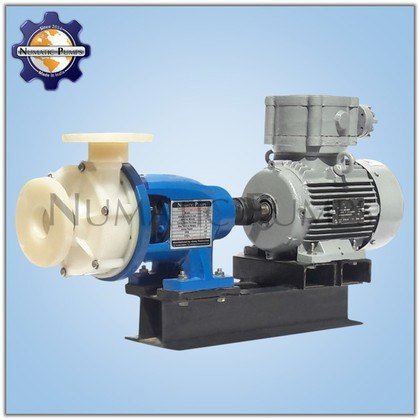
● Pump Type – Centrifugal, Horizontal, Coupled type, Non Self Priming Pump,
● Pump Material – Casing, Impeller and Back Plate is Made of PVDF (Polyvinylidene fluoride)
● Shaft – EN8 with Ceramic Sleeve
● Max Head – Up to 17 Meter
● Max Flow – 366 Liter per Minute
● Inlet & Outlet – 40 mm x 40 mm (Flange end Connection)
● Fluid Temperature – 100° C (Max)
● Seal Type – PTFE (Teflon) Bellow with Ceramic Vs GFT Facings, Ceramic Sleeve.
● Impeller – Semi Open Type, 120mm Diameter
Sulfuric acid can be safely moved from one tank, vessel, or process line to another with the help of a sulfuric acid transfer pump. Although the pump’s construction and materials are chosen to be compatible with extremely corrosive acid, it functions on the same fundamental principle as a centrifugal pump.
Mostly, two materials are used to transfer sulfuric acid
If the acid concentration is below 50%, then PP (Polypropylene) material is suitable
If the concentration is above 50%, then PVDF (Polyvinylidene fluoride) material is suitable.
The polymerization of vinylidene difluoride produces polyvinylidene fluoride or polyvinylidene difluoride, a highly non-reactive thermoplastic fluoropolymer. PVDF is a specialist plastic that is utilized in applications that need high purity and resistance to sulphuric acid H2SO4.
We are a committed group of people dedicated to ensuring the quality of our sulphuric acid Pumps. In our process we use the best PVDF (Polyvinylidene fluoride) raw material goods and technology with the same care and aim, so that only the most reliable products reach the final end-user. We are one of the leading sulphuric acid transfer pump Manufacturing Company in India and we have a well equipped facility with all the current equipment that may make a difference in our designs and keep our clients pleased with the final result. Our specialists apply their skills and many years of experience to give each design the right form and feature. We are one of the most trusted PP Pumps and PVDF Pumps Manufacturers in India and we try our level best to maintain the same. If you would like to purchase please contact us and we will assist you.
PVDF (Polyvinylidene Fluoride) coupled pumps are a type of centrifugal pump that is designed with a PVDF casing and impeller. PVDF is a high-performance thermoplastic material that is highly resistant to corrosion, abrasion, and chemical attack, making it suitable for use in aggressive and corrosive applications.
PVDF coupled pumps are commonly used in the following applications:
Chemical Processing: PVDF coupled pumps are used to transfer and circulate acids, alkalis, solvents, and other corrosive chemicals in chemical processing plants.
Pharmaceutical: PVDF coupled pumps are used to transfer and circulate pharmaceutical products such as vaccines, drugs, and biological fluids in pharmaceutical manufacturing.
Water Treatment: PVDF coupled pumps are used to transfer and circulate corrosive and aggressive chemicals in water treatment plants.
Metal Finishing: PVDF coupled pumps are used to transfer and circulate corrosive and aggressive chemicals in metal finishing operations.
Semiconductor Manufacturing: PVDF coupled pumps are used in semiconductor manufacturing to transfer and circulate corrosive and aggressive chemicals.
PVDF coupled pumps are available in various sizes and configurations to meet different application requirements, including flow rate, pressure, and temperature. They are designed with a close-coupled motor, which means that the motor is directly connected to the pump, eliminating the need for a separate coupling. This design makes the pump more compact and reduces the risk of misalignment between the motor and the pump.
PVDF coupled pumps require proper installation, operation, and maintenance to ensure their optimal performance and longevity. This includes regular inspection of the pump’s impeller, casing, and seals, as well as monitoring the pump’s operating conditions to prevent issues such as cavitation and overheating.
There are several types of PVDF coupled pumps available in the market, each designed to meet specific application requirements. Here are some common types of PVDF coupled pumps:
End Suction Centrifugal Pumps: These pumps have a single impeller and are designed for high flow rate and low to medium head applications. They are commonly used in water treatment, chemical processing, and metal finishing applications.
Self-Priming Centrifugal Pumps: These pumps are designed to automatically prime and re-prime themselves without the need for external priming. They are commonly used in chemical processing, pharmaceutical, and semiconductor manufacturing applications.
Mag-Drive Centrifugal Pumps: These pumps use a magnetic coupling to transmit power from the motor to the impeller, eliminating the need for a mechanical seal. They are commonly used in applications where leakage of pumped fluid is not allowed, such as in semiconductor manufacturing and pharmaceutical applications.
Vertical Inline Centrifugal Pumps: These pumps have a vertical shaft and are designed to be installed in a pipeline with the motor located above the pump. They are commonly used in water treatment, chemical processing, and metal finishing applications.
Air-Operated Double Diaphragm Pumps: These pumps use compressed air to operate two diaphragms that alternately draw in and discharge the pumped fluid. They are commonly used in applications where electricity is not available or where a pulsation-free flow is required, such as in chemical processing and metal finishing applications.
These are just some of the common types of PVDF coupled pumps. It’s essential to choose the right pump type and size for your specific application to ensure optimal performance and longevity. Consult with a pump expert or manufacturer to determine the best pump for your application.
PVDF coupled pumps are a type of centrifugal pump that is designed with a casing and impeller made of PVDF (Polyvinylidene Fluoride). PVDF is a high-performance thermoplastic material that is highly resistant to corrosion, abrasion, and chemical attack, making it suitable for use in aggressive and corrosive applications.
PVDF coupled pumps are used to transfer and circulate sulphuric and nitris acids and aggressive and corrosive fluids such as acids, alkalis, solvents, and other chemicals in various industries, including chemical processing, pharmaceutical, water treatment, metal finishing, and semiconductor manufacturing. They are preferred over other materials like stainless steel, cast iron, and plastic, which may not be suitable for highly corrosive environments.
PVDF coupled pumps are designed with a close-coupled motor, which means that the motor is directly connected to the pump, eliminating the need for a separate coupling. This design makes the pump more compact and reduces the risk of misalignment between the motor and the pump.
PVDF coupled pumps are available in various sizes and configurations to meet different application requirements, including flow rate, pressure, and temperature. They are highly efficient, durable, and require minimal maintenance. PVDF coupled pumps are also available in a range of types, including end suction centrifugal pumps, self-priming centrifugal pumps, mag-drive centrifugal pumps, vertical inline centrifugal pumps, and air-operated double diaphragm pumps.
Overall, PVDF Sulphuric Acid Transfer Pumps offer an excellent solution for industries that require reliable and efficient fluid transfer and circulation in highly corrosive environments.
PVDF coupled pump manufacturers typically follow a standard process to design, manufacture, and test their products. Here are some of the general steps involved in the process:
Design and Engineering: The first step in the process is to design the pump. Engineers use computer-aided design (CAD) software to create 3D models of the pump components and optimize the design for performance and durability.
Material Selection: The selection of materials is critical for PVDF coupled pumps as they are designed for use in highly corrosive environments. Manufacturers choose high-quality PVDF materials and other components such as seals, bearings, and impellers that are compatible with the fluid being pumped.
Manufacturing: The manufacturing process involves cutting, machining, and assembling the pump components. Machining operations such as milling, turning, and drilling are used to create the complex shapes required for pump components. The components are then assembled using specialized tools and techniques to ensure a precise fit and alignment.
Testing and Quality Control: After manufacturing, the pump is subjected to a series of tests to ensure that it meets the required specifications. These tests may include hydraulic testing, vibration testing, and noise testing. The pump is also inspected for quality control to ensure that it meets the manufacturer’s standards.
Shipping and Support: Once the pump is tested and approved, it is shipped to the customer. Manufacturers provide ongoing support to their customers, including technical support, maintenance services, and spare parts.
Manufacturers of PVDF coupled pumps often have specialized expertise and knowledge of the applications and environments in which their products are used. This enables them to provide customized solutions and support to their customers to ensure that the pumps perform optimally and meet the unique requirements of their applications.
Thank you for visiting our website and your interest in our products and services. If you have any further questions or would like more detailed please feel free to contact us.
Sulphuric Acid Transfer Pumps Manufacturers in India
Sulphuric Acid Transfer Pumps Pumps Manufacturers in Mumbai
Sulphuric Acid Transfer Pumps Pumps Manufacturers in Maharashtra
Sulphuric Acid Transfer Pumps Pumps Manufacturers in Thane
Sulphuric Acid Transfer Pumps Pumps Manufacturers in Gujarat
Sulphuric Acid Transfer Pumps Pumps Manufacturers in Ahmedabad
Sulphuric Acid Transfer Pumps Pumps Manufacturers in Vapi
Sulphuric Acid Transfer Pumps Pumps Manufacturers in Ankleshwar
Estd. 2014 © 2026 Numatic Pumps (All rights reserved)
Estd. 2022 © 2026 Unico Pumps (All rights reserved)